
Do you know how many cyberattacks happen every single minute across the globe? The number is staggering, and it’s rising every year. From phishing emails to ransomware attacks on hospitals, cyber threats are no longer someone else’s problem—they affect students, employees, and businesses alike. Whether you’re just starting your career or managing an entire IT infrastructure, understanding cybersecurity best practices in 2026 isn’t optional anymore. It’s essential for staying safe, employable, and one step ahead of attackers. If you’re also looking to build practical cybersecurity skills, enrolling in a Cyber Security Course in Pune can help you gain hands-on experience with real-world threats and defense strategies. Institutes like 3RI Technologies offer industry-focused training designed to prepare learners for today’s fast-changing cybersecurity landscape.
Why Cybersecurity Best Practices Matter More Than Ever in 2026
Cyber threats have evolved far beyond the simple viruses of the past. Today’s attackers use AI-powered phishing, deepfake scams, and automated malware that can bypass outdated defenses within seconds. The attack surface available to hackers is growing along with remote work, cloud computing, and IoT devices.


Recent cybersecurity attacks on banks, hospitals, and government systems have shown that no organization is too small or too big to be targeted. A single unpatched system or a careless click on a malicious link can compromise an entire network. This is why every individual and organization needs to follow a proven cybersecurity best practice, not as a one-time checkbox exercise, but as an ongoing habit built into daily work.
Why following cybersecurity best practices is essential
- Protects sensitive data: Keeps personal and business information safe from cyber threats and unauthorized access.
- Reduces financial losses: Helps avoid the high costs of cyberattacks, fraud, and data recovery.
- Builds customer trust: Strong security practices increase confidence and strengthen your brand’s reputation.
- Supports compliance: Helps organizations meet data protection and cybersecurity regulations.
- Reduces downtime: Enables faster recovery from cyber incidents and keeps operations running smoothly.
There’s also a growing concern: the cybersecurity learning . Millions of positions remain unfilled worldwide because there simply aren’t enough trained professionals to defend against modern cyber threats and solutions. This gap is exactly why structured learning, such as a Cyber Security Classes in Pune, has become so valuable.
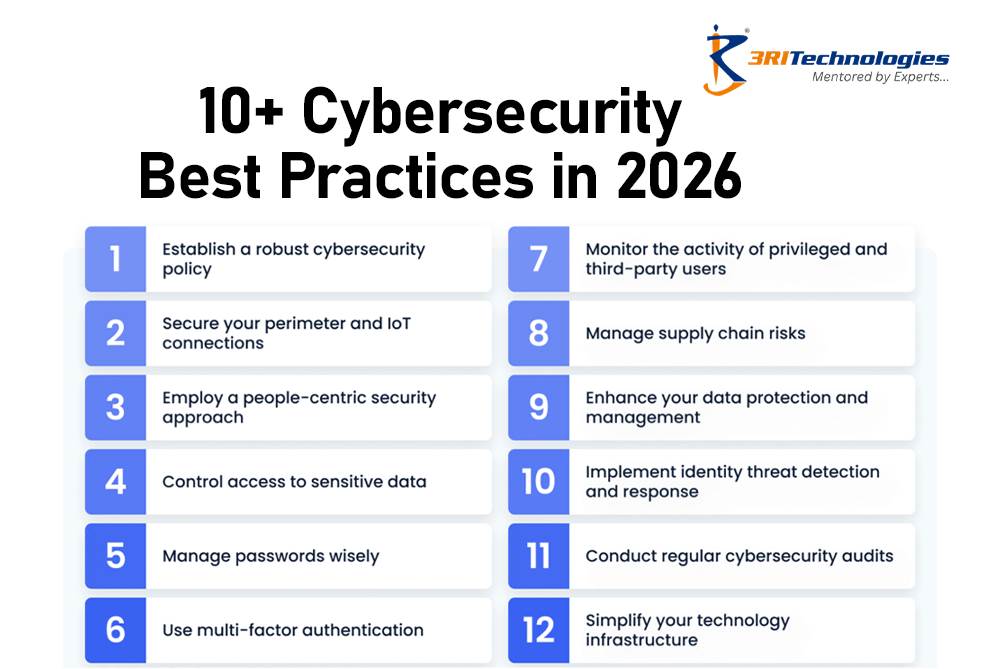
10+ Cybersecurity Best Practices You Should Follow in 2026 (With Real-World Examples)
Building strong cyber resilience doesn’t require expensive tools or a computer science degree — it starts with consistent, everyday habits. Below are the most important best practices that every beginner, student, and working professional should follow, along with real examples that show why they matter.
1. Use Strong, Unique Passwords
Weak passwords remain one of the most common reasons behind data breaches, and yet many people still reuse the same password across several accounts. Once one platform is compromised, attackers often try the same credentials elsewhere, a technique known as credential stuffing. One of the easiest methods to reduce your risk right away is to develop the habit of making strong, one-of-a-kind passwords for each account.
- Use a combination of symbols, numbers, and letters
- Steer clear of private information like names or birthdays
- To safely store credentials, use a password manager.

2. Turn on multi-factor authentication (MFA)
Sensitive accounts can no longer be protected with passwords alone, especially as phishing kits becoming more complex. In order to prevent an attacker from gaining access even in the event that a password is compromised, multi-factor authentication provides a second tier of verification. It’s a small setup effort that offers a significant boost in protection.
- Whenever feasible, use authenticator apps rather than SMS
- Enable MFA on email, banking, and work accounts
- Review MFA settings periodically for outdated devices

3. Keep Software and Systems Updated
Because vulnerabilities in outdated software are well known and regularly exploited, outdated software is one of the simplest places for attackers to enter. Delaying an update might feel harmless, but it can leave a known gap wide open for months. Making updates a habit instead than an afterthought closes that window before it can be abused.
- Whenever feasible, turn on automatic updates
- Patch operating systems and apps on a regular basis.
- Retire legacy software that isn’t supported

4. Be Cautious with Phishing Emails
Phishing continues to be the most common way attackers gain initial access, often disguised as a message from a bank, employer, or delivery service. These emails are designed to create urgency so people click before thinking. Slowing down for just a few seconds to verify a sender is usually enough to avoid falling for the trick.
- Verify sender email addresses carefully
- Avoid clicking unknown links or attachments
- Report suspicious emails to your IT team

5. Secure Your Wi-Fi and Network
An unsecured home or office network gives attackers an easy way to intercept traffic or slip into connected devices. Many people never change their router’s default settings, which makes this an easy target. A few configuration changes can make your network significantly harder to break into.
- Use WPA3 encryption where available
- Change default router usernames and passwords
- Create a distinct guest network for guests

6. Make Regular Data Backups
Ransomware attacks work by locking access to your data, which means backups are often the only real way to recover without paying a ransom. However, backups are usually neglected until an issue arises. Testing your recovery process, not just creating backups, is what actually makes this practice reliable when you need it most.
- Observe the 3-2-1 backup guideline (three copies, two media types, and one offsite)
- Periodically test backup restoration
- Automate backup schedules so nothing is missed

7. Use the Least Privilege Principle to Restrict Access
Not every employee needs access to every system or file, yet many organizations grant broad permissions out of convenience. This becomes risky the moment one account is compromised, since attackers can move freely across connected systems. Restricting access to only what’s necessary limits the damage a single breach can cause.
- Assign role-based access controls
- Review user permissions on a regular schedule
- Remove access immediately after an employee exits

8. Invest in Employee Awareness Training
Technology alone can’t stop a breach if an employee unknowingly opens the door to it. Human error remains one of the leading causes behind successful attacks, which is why a well-structured cybersecurity awareness program is so valuable. Training employees to recognize suspicious behavior turns your workforce into an active line of defense rather than a weak point.
- Conduct regular phishing simulation tests
- Train staff on social engineering tactics
- Promote a culture where people report suspicious activity fearlessly

9. Protect Sensitive Information
Even with strong defenses in place, data can still be stolen through a lost device, an intercepted transfer, or an insider mistake. By ensuring that stolen data cannot be read without the right key, encryption greatly lessens the consequences of a breach. It’s one of those practices that works quietly in the background but matters enormously when something goes wrong.
- Encrypt data while it’s in transit and at rest.
- Make use of safe, authorized file-sharing resources
- Avoid storing sensitive data on personal devices

10. Monitor Networks Continuously
Attacks rarely happen instantly; they often unfold over days or weeks as intruders quietly explore a network before striking. Ongoing surveillance aids in identifying this anomalous activity before it develops into a serious breach. This level of visibility frequently makes the difference between a minor incident and a significant problem for businesses.
- Use intrusion detection systems (IDS)
- Set up automated alerts for unusual behavior
- Conduct regular security audits
11. Have an Incident Response Plan
Even organizations with strong defenses eventually face some kind of security incident, and how they respond matters just as much as prevention. Without a clear plan, teams waste critical time figuring out who does what during an actual crisis. Preparing in advance turns a chaotic situation into a manageable, structured response.
- Define roles and responsibilities in advance
- Practice simulated breach scenarios periodically
- Document lessons learned after every incident
As cyber threats continue to evolve, many learners are choosing practical training to build job-ready skills. Enrolling in a Cyber Security Course in Pune with Placement offers hands-on experience with real-world attack scenarios while helping candidates prepare for recognized industry certifications. Institutes such as 3RI Technologies focus on practical labs and live simulations, giving students the confidence to tackle today’s cybersecurity challenges.
The Most Typical Cybersecurity Errors You Should Avoid
Most security-conscious individuals fall into well-known pitfalls. If basic security procedures are neglected, even the safest companies can become targets of cyberattacks and threats. Below are some common mistakes that put individuals and organizations at greater risk:
| Common Mistake | Why It Could Be Dangerous |
| Using the same password repeatedly | Using one password for multiple accounts makes it easier for attackers to access several accounts if one password is compromised. |
| Skipping software updates | Delaying updates can leave devices exposed to known security vulnerabilities that cybercriminals actively exploit. |
| Clicking suspicious email links | Fraudulent emails often contain malicious links that can steal personal information or install malware. |
| Downloading files from untrusted websites | Files from unknown sources may contain viruses, ransomware, or other harmful software. |
| Sharing sensitive information on unsecured networks | Public or unsecured Wi-Fi can make confidential data easier for attackers to intercept. |
| Giving users permissions they don’t need | Giving users more access than they require raises the possibility of unintentional alterations or illegal data access. |
| Not routinely backing up crucial data | Recovering from ransomware attacks, system malfunctions, or unintentional data loss becomes far more challenging in the absence of recent backups. |
| Delaying the reporting of suspicious activities | Reporting unusual activity quickly helps security teams respond faster and reduce the impact of potential cyber incidents. |
The majority of security errors are the result of ignorance rather than carelessness. Regular learning through Cyber Security Courses Near Me and a well-designed cybersecurity awareness program equips people with the skills to identify risks and respond confidently to evolving cyber threats.
Simple Steps to Strengthen Your Cybersecurity Skills and Awareness
You don’t have to become an expert at everything at once. Focus on one cybersecurity best practice at a time, practice it regularly, and continue learning to strengthen your expertise while addressing the rising cybersecurity skills gap in the industry:
Practical ways to improve your cybersecurity skills
- Practice in virtual cybersecurity labs to gain hands-on experience in a safe and controlled environment.
- Learn networking fundamentals to understand how systems communicate and where security risks can arise.
- Examine ethical hacking principles to find weaknesses before hackers may take use of them.
- Participate in Capture the Flag (CTF) competitions to improve your problem-solving and practical cybersecurity skills.
- Follow trusted cybersecurity news sources to stay informed about the latest threats, trends, and security updates.
- Learn cloud security basics to protect data and applications in modern cloud environments.
- Discover how artificial intelligence is used to identify and address cyberthreats by investigating AI-powered security products.
- Build hands-on cybersecurity projects to strengthen your practical knowledge and create a portfolio that showcases your skills.
practical training combined with career guidance makes the transition into the field much smoother. Reputed providers offering Cyber Security Training in Pune focus on real-world labs, certifications, and mentorship, making them a solid starting point for beginners and working professionals alike.



Conclusion
Cybersecurity in 2026 isn’t just an IT department’s responsibility — it’s a shared necessity across every role and industry. By following these best practices, from strong passwords and MFA to continuous monitoring and employee training, you can significantly reduce your exposure to cyber threats and attacks.
If you’re serious about building a career in this field or simply want to strengthen your organization’s defenses, consider enrolling in one of the Best Cyber Security Courses in Pune. 3RI Technologies, as an educational institute, offers structured, industry-relevant training designed to help students and professionals build practical skills, earn recognized certifications, and confidently step into the cybersecurity field with the right guidance and support.