
From choosing the right course to landing your first role — a practical, honest guide for students and professionals in Pune’s growing data ecosystem.
You’ve likely come across headlines and social media posts calling data science one of the most promising career fields today. While that may be true, many learners face a more practical question after completing their training: What comes next? After finishing a Data Science Course in Pune, it’s natural to wonder which career paths are available, what skills employers actually expect, and how to turn your learning into a real job opportunity.
The journey from classroom training to a successful career isn’t always straightforward. Some professionals move into data analyst roles, while others explore machine learning, business intelligence, or data engineering. The key is understanding the opportunities ahead and preparing for them strategically.
This guide is designed to give you a realistic view of the career roadmap after data science training. It covers the roles you can pursue, the skills that matter most, and the steps that can help you move closer to your first—or next—job in the data industry, without unrealistic promises or confusing technical jargon.


Why Choose the Right Data Science Institute in Pune
It’s crucial to start with the appropriate training before making plans for your data science career.. Pune offers plenty of options, but selecting a course based only on marketing claims can lead to disappointment. Instead, focus on results. The best data science course in Pune with placement support should be able to demonstrate real success stories through verified alumni profiles, hiring partners, and actual job roles secured by students.
Look beyond attractive brochures and website promises. Check whether the program includes hands-on projects, industry-relevant tools, mentorship from experienced trainers, interview preparation, and dedicated placement assistance. Speaking with former students can help you have a better picture of the educational process and career outcomes. A strong foundation built through quality training and practical exposure can make the transition from learning data science to landing a job much smoother.

Here is a brief assessment of the characteristics that set strong institutes apart from mediocre ones:
| Factor | Strong Institute | Average Institute |
| Curriculum updates | Updated every 6 months with industry input | Same syllabus for 2–3 years |
| Faculty | Working data professionals with real projects | Mostly academic or ex-IT generalists |
| Placement support | Dedicated team, mock interviews, referrals | Job board access only |
| Tools taught | Python, SQL, Tableau, Spark, scikit-learn, TensorFlow | Mostly Excel & basic Python |
| Projects | 3–5 live capstone projects with datasets | 1 demo project from YouTube |
| Batch size | 20–30 (focused attention) | 60+ (hard to get individual feedback) |
Also ask about the data science roadmap built into the curriculum. A well-structured course shouldn’t just teach tools in isolation — it should show you how Python connects to machine learning, how SQL leads to data engineering work, and how visualisation skills land you in analytics roles.
- Ask for a list of companies that hired from the last three batches
- Speak to an actual alumnus before enrolling — most good institutes will facilitate this
- Check if the institute covers both data science and machine learning together, or treats them as disconnected modules
- Look at whether the course teaches storytelling and business context alongside technical skills
What the Data Science Course Covers — And How Each Module Connects to a Real Job Role
One thing many students don’t realise until they’re already job-hunting: not every module you learn is equally useful for every role. Understanding the connection between what you’re studying and where it takes you professionally changes how you approach the course.
A well-built Data Science Course in Pune with Placement typically flows through these core areas:
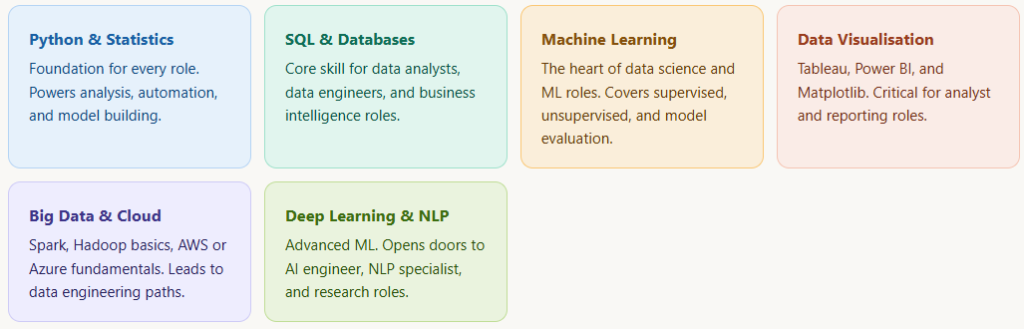
Here’s the part that matters most: each module isn’t just theory — it’s a door to a specific job title.
| Module / Skill Area | Data Science Tool | Job Role It Opens | Level |
| Python + Statistics | NumPy, Pandas | Data Analyst, Research Analyst | Entry |
| SQL + EDA | MySQL, PostgreSQL | Business Analyst, BI Analyst | Entry |
| Machine Learning | scikit-learn, XGBoost | Data Scientist, ML Engineer | Mid |
| Data Pipelines + Cloud | Spark, Airflow, AWS | Data Engineer | Mid |
| Deep Learning + NLP | TensorFlow, PyTorch, Hugging Face | AI Engineer, NLP Specialist | Senior |
| BI Tools + Storytelling | Tableau, Power BI | Analytics Consultant, BI Developer | Entry–Mid |
Career Opportunities in Pune Following Completion of a Data Science Course
This is where the journey starts to feel rewarding. In the future, Data science will continue to expand across industries, opening doors for individuals with the necessary abilities. Pune’s robust technology environment is one benefit of developing your career there. From fast-growing startups and product-based companies to established IT firms and multinational organizations, there are plenty of opportunities to explore locally. That means you can pursue a wide range of data science roles and gain valuable industry experience without necessarily moving to another city.
1. Data Analyst
Best suited for beginners entering the industry.
Responsibilities:
- Analyze business data
- Create dashboards
- Generate reports
- Identify trends
2. Data Scientist
Large datasets are used by data scientists to create predictive models and produce useful insights.
Responsibilities:
- Machine learning
- Predictive analytics
- Statistical modeling
- Business recommendations
3. Data Engineer
Building and maintaining data infrastructure is the primary emphasis of a data engineer.
Responsibilities:
- Data pipelines
- Database architecture
- Data warehousing
- Cloud integration
4. Machine Learning Engineer
Ideal for professionals interested in advanced AI applications.
Responsibilities:
- Model deployment
- Algorithm optimization
- Production systems
5. BI Developer
creates reporting systems and dashboards for business teams utilizing Looker, Tableau, or Power BI.
Responsibilities:
- Create dashboards and reports for business insights.
- Analyze and interpret data from multiple sources.
- Develop and optimize SQL queries.
- Support decision-making with data-driven recommendations.
6. AI/NLP Engineer
Works with large language models, chatbots, and NLP pipelines. Fastest-growing specialisation right now.



Responsibilities:
- Build and train AI/NLP models.
- Process and analyze text data.
- Improve model accuracy and performance.
- Integrate AI solutions into applications.
Which path suits you? It largely depends on two things — what modules you enjoyed most during training, and how much coding you genuinely want to do. Analysts do less, engineers do the most. Scientists sit somewhere in between.
From Course Completion to First Job — How Placement Support Works at Every Step
Finishing a course is only the beginning. When it comes time to transform your skills into an employment opportunity, that’s when the real battle usually starts. Strong placement support can make this transition easier by providing guidance, interview preparation, and job opportunities—but the best results come when you actively participate, practice consistently, and make the most of the support available. A good Data Science Course in Pune with Placement goes beyond teaching tools and concepts. It helps students build job-ready skills, gain practical experience, and confidently take the next step toward starting a career in the data industry.
A reputed Data Science Training Institute in Pune typically follows a structured placement process designed to help students steadily progress from skill-building to job opportunities, week by week:
1. Resume & Portfolio Review (Week 1 post-course)
Career team audits your resume, GitHub profile, and project documentation. Common fixes: weak project descriptions, missing metrics, generic summaries.
2. Mock Technical Interviews (Week 2–3)
You’ll be asked SQL queries, Python problems, ML case studies, and “explain your project” questions. These sessions reveal gaps before real interviews do.
3. Company Introductions & Referrals (Week 3–5)
The institute shares your profile with hiring partners.Warm referrals convert at much higher rates than cold applications, which is why alumni networks are important.
4. HR Round Prep & Salary Negotiation (Week 5–6)
Most candidates undervalue themselves. A good placement team coaches you on how to talk about your fresher data science projects and anchor your salary expectations correctly.
5. Offer & Post-Joining Support (Ongoing)
The best institutes stay connected after you join. That 90-day check-in, help with a tricky work problem, or nudge toward an internal team switch — it’s more valuable than people expect.
Resume Building and LinkedIn Optimisation for Data Science Roles
Your resume and LinkedIn profile are doing active work even when you’re asleep — or they should be. In data science, where hiring managers scan hundreds of profiles, clarity and specificity beat length every time.
Resume: What actually gets read
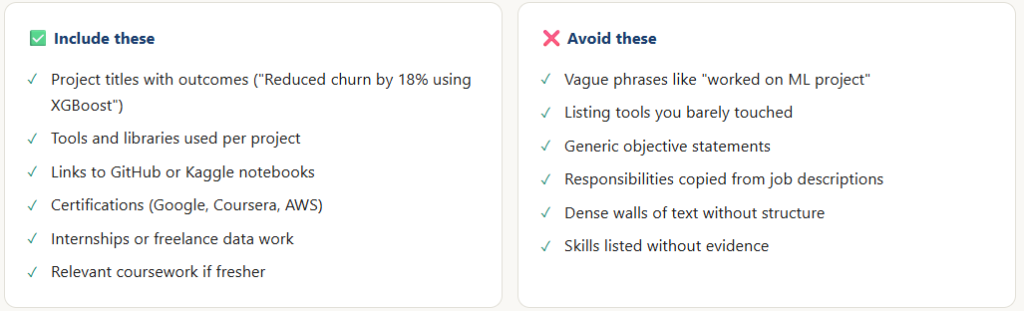
Resume Formula
Skill + Project + Business Impact = Strong Resume Point
LinkedIn: The part most people miss
Your headline shouldn’t just say “Data Science Student.” Recruiters search for specific terms — make it work harder:
- Write a first-person About section that sounds like a person, not a job board listing
- Pin your 2–3 best projects in the Featured section — include screenshots of dashboards or model outputs
- Connect with Pune-based data professionals and comment thoughtfully on their posts (visibility compounds over time)
- Before you apply, follow the businesses you want to work for and interact with their content.
- Add skills like Python, Machine Learning, SQL, Tableau, and Data Engineering — recruiters filter by these
- Request one genuine recommendation from your course mentor or project supervisor.
Professional Headline
Instead of: “Looking for Opportunities”
Use: “Aspiring Data Scientist | Python | SQL | Machine Learning | Data Analytics”
Projects are your proof of work
For freshers, projects often speak louder than certifications. A few well-executed projects that clearly showcase the problem, approach, results, and code can significantly strengthen your profile. Share them on GitHub with clear documentation, and include the links on your resume, LinkedIn profile, and other professional platforms to make your work easily accessible to recruiters.