
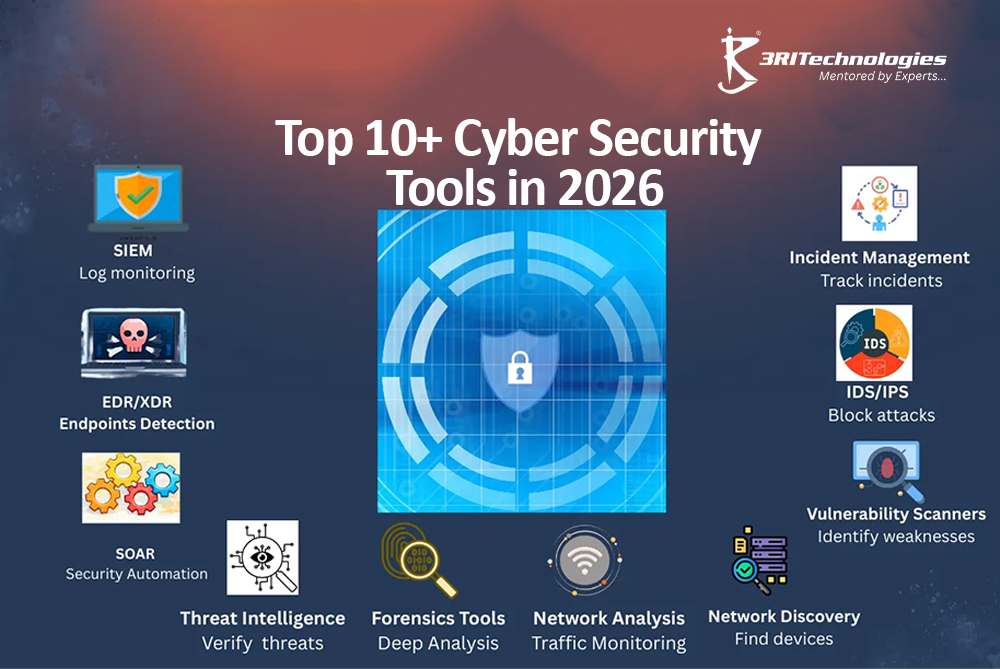
Every year, cyber threats become more complex, making digital security a major concern for businesses in all sectors of the economy. Businesses rely on advanced Cyber Security Tools to protect their networks, cloud environments, applications, and sensitive information from evolving attacks. Cyber Security Training in Pune helps students and IT professionals develop practical skills to understand, use, and manage these tools effectively in real-world scenarios. In this guide, you’ll explore the top cybersecurity tools in 2026, their key uses, and how learning them can prepare you for a rewarding career in the cybersecurity industry.
Why Cyber Security Tools Are Essential in 2026
Cybercriminals are constantly developing new attack techniques, making traditional security methods insufficient. Modern organizations need intelligent security solutions that can monitor systems continuously, detect threats instantly, and respond before serious damage occurs.
Today’s Cyber Security Tools help businesses secure their digital infrastructure by combining automation, artificial intelligence, and real-time monitoring. They are used in banking, healthcare, IT companies, manufacturing, government organizations, and startups. Organizations benefit from these tools:
- Real-time cyber threat detection
- Protect cloud and on-premise environments
- Identify software vulnerabilities before attackers exploit them
- servers and laptops that are secure endpoints
- Automation can reduce the amount of manual security work
- Compliance with legal and regulatory requirements
- Improve incident investigation and response
Students who start their Cyber Security training in Pune with practical experience learn more about how security teams operate in real-world environments.
Top 10+ Best Cyber Security Tools You Should Know
1. Wireshark
Wireshark is a network traffic analysis tool that allows security professionals to examine every data packet traveling across a network. It helps identify unusual communication, troubleshoot connectivity issues, and investigate suspicious activity. For students, it provides an excellent way to understand how computer networks function in real time.
Key Highlights
- Captures live network traffic
- Analyzes communication between devices
- Detects suspicious network activity
- Useful for networking and security learning
2. Nmap
Nmap is a popular network scanning program that finds connected devices, open ports, and active services. It is used by security administrators and ethical hackers to understand network architecture and identify possible security flaws before attackers can take advantage of them.
Key Highlights
- Scans networks quickly
- Finds active hosts
- Detects operating systems
- Supports vulnerability assessments
3. Metasploit
Metasploit is a widely used framework for penetration testing. It helps cybersecurity professionals safely simulate attacks on systems to verify whether vulnerabilities exist. Students use it to understand how ethical hacking works while learning responsible security testing practices.
Key Highlights
- Performs penetration testing
- Simulates real cyberattacks
- Large exploit database
- Excellent for ethical hacking practice
4. Burp Suite
Web application security testing is the purpose of Burp Suite. It allows professionals to inspect website traffic, discover vulnerabilities, and test application security before deployment. Learning Burp Suite helps students understand common web-based attacks and secure coding practices.
Key Highlights
- Tests website security
- Detects web vulnerabilities
- Intercepts browser requests
- Supports manual and automated testing



5. Nessus
Nessus is a vulnerability scanner that checks computers, servers, and networks for known security weaknNessus is a vulnerability scanner that looks for known security flaws in computers, servers, and networks. Organizations use it regularly to identify outdated software, missing patches, and configuration errors that may create security risks.
Key Highlights
- Identifies vulnerabilities
- Generates detailed reports
- Supports compliance audits
- Easy-to-read scan results
6. Splunk
Splunk is a platform for Security Information and Event Management (SIEM) that gathers and examines logs from various systems. Security teams use it to monitor threats, investigate incidents, and gain complete visibility across their IT infrastructure.
Key Highlights
- Centralized log management
- Real-time security monitoring
- Incident investigation
- Visual dashboards and reports
7. Kali Linux
Kali Linux is a specialized operating system built for cybersecurity professionals. It includes hundreds of pre-installed tools for penetration testing, digital forensics, wireless security, and vulnerability assessment, making it one of the most important learning platforms for beginners.
Key Highlights
- Includes numerous security tools
- Supports penetration testing
- Ideal for cybersecurity labs
- Popular among ethical hackers
8. John the Ripper
John the Ripper is a password auditing tool that determines how secure user passwords are. It helps organizations identify weak credentials and improve authentication security by encouraging stronger password policies.
Key Highlights
- Password security testing
- Supports multiple formats
- Identifies weak passwords
- Improves authentication security
9. Snort
An intrusion detection and prevention system (IDS/IPS) called Snort constantly scans network traffic for unusual activity. It immediately alerts administrators when unusual activity is detected, helping organizations respond quickly to potential attacks.
Key Highlights
- Detects intrusions
- Real-time network monitoring
- Customizable security rules
- Prevents network attacks
10. OpenVAS
Networks and systems can be scanned for security vulnerabilities using OpenVAS, an open-source solution. It provides detailed reports that help organizations in identifying and addressing vulnerabilities before they become serious risks.
Key Highlights
- Open-source security scanner
- Regular vulnerability updates
- Detailed reporting
- Suitable for learning and enterprise use
11. CrowdStrike Falcon
A cloud-native endpoint security software called CrowdStrike Falcon uses artificial intelligence to identify modern cyberthreats.. It protects devices from malware, ransomware, and advanced attacks while providing centralized security management.
Key Highlights
- AI-powered threat detection
- Endpoint protection
- Cloud-based management
- Enterprise-level security
12. Microsoft Defender for Endpoint
Microsoft Defender for Endpoint provides advanced protection for business devices by detecting threats, investigating suspicious activities, and automating security responses. It integrates seamlessly with Microsoft environments used by many organizations.
Key Highlights
- Advanced endpoint security
- Threat intelligence
- Automated response
- Easy Microsoft integration
How a Cyber Security Course in Pune Can Help You Master These Tools
Learning cybersecurity is most effective when theory is combined with practical experience. A structured Cyber Security Course in Pune helps students understand how industry-standard tools are used to monitor networks, identify vulnerabilities, perform ethical hacking, investigate security incidents, and secure modern IT environments.


Instead of learning tools individually, students progress through a guided curriculum that builds strong technical fundamentals before moving to advanced cybersecurity concepts. Practical assignments, security labs, and project-based learning make it easier to apply knowledge in real business scenarios.3RI Technologies supports students by offering industry-focused training designed to improve both technical knowledge and career readiness. Students benefit from:
- Hands-on practice with popular Cyber Security Tools
- Experienced trainers with industry knowledge
- Live projects to build practical confidence
- Mock interviews and resume guidance
- Placement assistance for eligible candidates
- Options for flexible learning for both working professionals and students
- Preparation for globally recognized Cyber Security Certification
- Continuous learning support throughout the training journey
In addition to preparing students for positions like Security Analyst, SOC Analyst, Ethical Hacker, Penetration Tester, and Information Security Engineer, this hands-on learning method helps students gain the confidence to carry out real-world cybersecurity activities. By building hands-on experience with industry-standard tools, learners are better equipped to explore rewarding Career Opportunities in Cyber Security across various sectors.
Key Elements and Advantages of Modern Cybersecurity Tools
Modern cybersecurity solutions combine automation, cloud security, artificial intelligence, and advanced analytics to strengthen an organization’s overall security posture. Threat detection is enhanced by these technologies, which also shorten the time needed for event investigation and response.
| Key Feature | Benefit |
| Real-time monitoring | Detects threats before they cause serious damage |
| AI-powered threat detection | Identifies advanced attacks with greater accuracy |
| Vulnerability scanning | Finds security weaknesses early |
| Endpoint protection | Secures laptops, desktops, and servers |
| Security automation | Reduces repetitive manual tasks |
| Cloud security support | secures cloud infrastructure and apps. |
| Centralized log management | Simplifies security monitoring and investigations |
| Compliance reporting | Helps organizations meet industry regulations |
| Threat intelligence | Improves decision-making during incidents |
| Incident response | Enables faster recovery from cyberattacks |
Additional advantages include:
- Better visibility across enterprise systems
- Improved business continuity
- Reduced security risks
- Faster decision-making during cyber incidents
- Higher demand for skilled cybersecurity professionals
- Strong Cyber Security salary potential across multiple industries
Conclusion
The cybersecurity sector is constantly changing as businesses deal with more complex online threats. Understanding leading Cyber Security Tools such as Wireshark, Nmap, Splunk, Burp Suite, Kali Linux, and Nessus helps students develop practical skills that employers actively seek. Gaining hands-on experience with these technologies through a Cyber Security Course in Pune can strengthen your technical knowledge, improve your employability, and prepare you for long-term success in the cybersecurity field.