
Every organization today runs on data-driven decisions, and someone has to translate business problems into practical solutions. That someone is usually a Business Analyst. The need for a quality Business analyst course in Pune is increasing among both recent graduates and experienced professionals since businesses of all sizes, from startups to multinational corporations, are seeking experts who can bridge the gap between business objectives and technology. If you’re curious about what a Business Analyst actually does, what skills the role demands, and how much it pays in India, this guide covers everything you need to know before you plan your next career move.
Purpose and Significance of a Business Analyst
A business analyst (BA) is a specialist who examines business procedures, finds issues, and suggests fixes to boost productivity, profitability, or customer satisfaction. In simple terms, a BA acts as a translator between business stakeholders (who understand the “what” and “why”) and technical teams (who handle the “how”).
The Business Analyst role has grown far beyond documentation. Today’s BAs work closely with product managers, developers, and leadership teams to shape strategy, evaluate risks, and ensure that projects deliver real business value.
Why does this role matter so much?
- Businesses lose money when requirements are misunderstood or poorly communicated.
- A skilled BA reduces project failure rates by catching gaps early.
- Companies across banking, IT, healthcare, retail, and manufacturing depend on BAs to guide digital transformation initiatives.
- Professionals with the ability to analyze and act upon data are in greater demand as it becomes increasingly important in decision-making.
For example, when a retail company wants to launch a new loyalty program, a Business Analyst studies customer buying patterns, consults with marketing and IT teams, and drafts a requirement document that developers use to build the actual system. Without this bridge, projects often go over budget or miss customer needs entirely.
Business Analyst Roles and Responsibilities
The Business Analyst role varies slightly depending on industry and company size, but the core responsibilities remain fairly consistent. Here’s what a typical day looks like:
- Requirement gathering – Meeting with stakeholders to understand business needs, pain points, and goals.
- Documentation – generating user stories, functional specification documents (FSDs), and business requirement documents (BRDs).
- Data analysis – Studying trends, reports, and KPIs to identify areas of improvement.
- Process mapping – Designing “as-is” and “to-be” workflows using tools like Visio or Lucidchart.
- Stakeholder communication –operating as an intermediary between QA testers, developers, and business teams.
- Solution testing and validation – ensuring that the final solution truly resolves the initial business issue.
- Change management support – supporting teams’ easy transition to new procedures or systems.
Depending on the organization, a BA may specialize further, and each specialization leans on a slightly different skill set:
- IT Business Analyst – Focuses on software requirements and works closely with developers, so a strong grip on SQL, wireframing, and system documentation is essential.
- Data Business Analyst – Leans toward analytics and reporting, requiring comfort with Excel, Power BI, and interpreting large datasets to guide decisions.
- Product Business Analyst – Works with product managers on feature planning and roadmaps, so market research skills and user-story writing matter more here.
This variety is exactly why many professionals are now enrolling in a Business Analyst Course in Pune, where structured, industry-aligned training helps them gain hands-on exposure to these responsibilities through real business case studies rather than just theory.
Key Skills for Becoming a Business Analyst
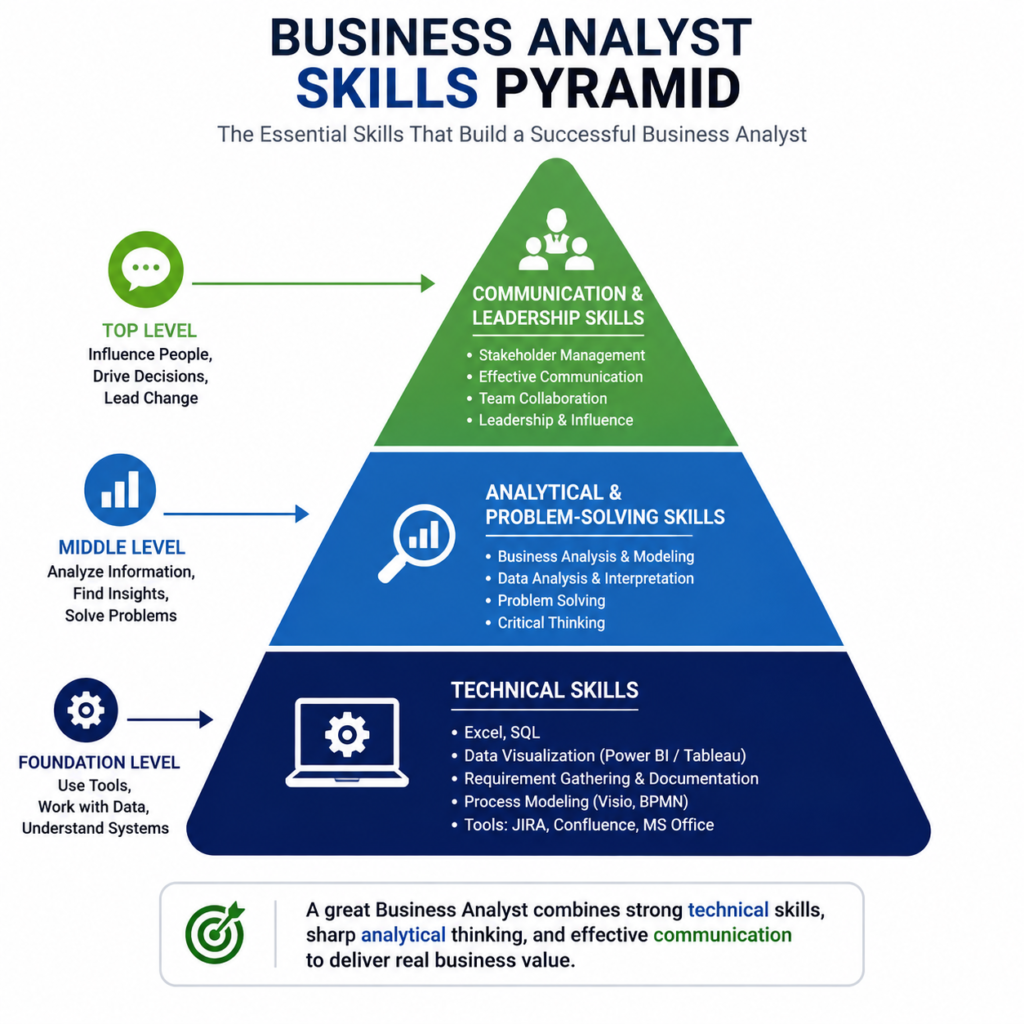
Becoming a successful Business Analyst requires a blend of technical know-how and interpersonal ability. Institutes like 3RI Technologies teach these exact technical and soft skills through real tools and live projects, so learners don’t just understand the concepts on paper but get properly prepared to handle interview questions and on-the-job scenarios with confidence. The most important business analyst skills are broken down as follows:
Technical Skills
- Proficiency in Excel, SQL, and basic data visualization tools like Power BI or Tableau
- Understanding of the Scrum and Agile approaches
- knowledge of process modeling software, such as Lucidchart, BPMN, and Visio
- Fundamental understanding of databases and reporting software
- Exposure to Trello or JIRA, two project management systems


Soft Skills
- Strong analytical and problem-solving ability
- Clear written and verbal communication
- Active listening and stakeholder management
- Critical thinking to spot inefficiencies others might miss
- Adaptability, since business needs and priorities shift often
Certifications also strengthen a resume considerably. A recognized business analyst certification such as CBAP (Certified Business Analysis Professional), PMI-PBA, or ECBA signals credibility to employers and often accelerates promotions.
| Skill Category | Examples | Why It Matters |
| Technical | SQL, Excel, Power BI, Agile | Helps analyze data and manage projects efficiently |
| Communication | Presentations, documentation, stakeholder meetings | Ensures requirements are understood correctly |
| Analytical | Root cause analysis, process mapping | Identifies real business problems, not just symptoms |
| Certification | CBAP, ECBA, PMI-PBA | Validates expertise and boosts credibility |
Since most recruiters expect candidates to demonstrate these skills through real projects, many aspirants prefer structured Business Analyst classes in Pune that combine live tools, case studies, and mentorship instead of self-study alone.
Business Analyst Salary, Career Growth, and Job Opportunities
One of the biggest draws toward this career is the earning potential, which grows steadily with experience and domain expertise.
Approximate Business Analyst salary in India (based on current industry data):
- Freshers (0–2 years): ₹4–6 LPA
- Mid-level (2–5 years): ₹6–12 LPA
- Senior/Lead BAs (5+ years): ₹12–20 LPA or higher, especially in banking, fintech, and consulting
| Job Role | Experience Level | Expected Salary (India) | Key Skills |
| Associate/Junior Business Analyst | 0–2 years | ₹4–6 LPA | Excel, requirement gathering, basic SQL |
| Business Analyst | 2–5 years | ₹6–12 LPA | Process mapping, stakeholder communication, Agile |
| Senior Business Analyst | 5–8 years | ₹12–18 LPA | Advanced SQL, Power BI, domain expertise |
| Lead/Manager of Business Analysis | 8+ years | ₹18–25+ LPA | Team leadership, strategic planning, certifications |
Salaries also vary by city and industry. Bengaluru, Mumbai, Pune, and Gurugram generally offer higher packages due to the concentration of IT hubs, product companies, and consulting firms. Professionals holding a business analyst certification or an MBA typically command a premium over non-certified peers.
Career growth in this field is fairly linear and rewarding. A typical progression looks like this:
- Junior/Associate Business Analyst
- Business Analyst
- Senior Business Analyst
- Business Analysis Manager or Product Owner
- Head of Business Analysis / Director of Strategy
Depending on their interests and further skill development, many professionals also go into similar positions like project manager, product manager, or data analyst. Since the two career paths often overlap, it’s worth checking how data analyst salary in India for freshers and experienced professionals stacks up before deciding which direction suits you better.
There are still many job prospects in a variety of industries, including manufacturing, e-commerce, banking and financial services, IT services, and healthcare. As more companies undergo digital transformation, this demand is expected to keep climbing over the next several years.
Conclusion
A business analyst career offers a rare combination of intellectual challenge, steady demand, and strong financial growth. The position is useful in almost every industry since it lies at the center of technology and business strategy. Success in this field depends on developing the right mix of technical tools, analytical thinking, and communication skills, along with relevant certifications that validate your expertise. Whether you’re a fresh graduate exploring career options or a working professional planning a switch, investing time in structured Business Analyst training in Pune can give you the practical foundation and confidence needed to enter this growing field and build a long-term, rewarding career.



Frequently Asked Questions (FAQs)
1. What minimum qualifications are required to work as a business analyst?
The majority of companies favor a bachelor’s degree in business, IT, commerce, or a similar discipline. An MBA or relevant certification can further strengthen your profile, though it isn’t always mandatory for entry-level roles.
2. Is coding knowledge required for a Business Analyst role?
Not extensively. Basic SQL and familiarity with data tools help, and structured programs like the ones at 3RI Technologies cover just enough hands-on SQL and reporting practice to get learners comfortable without overwhelming them with heavy programming.
3. Which certification is best for a Business Analyst career?
CBAP, ECBA, and PMI-PBA are among the most recognized certifications globally. The best one depends on your level of experience and professional objectives.
4. How much time does it take to become a qualified business analyst?
With focused training, most learners can become job-ready in 3 to 6 months, especially when the course includes practical projects and tool-based training.
5. In which sectors are business analysts most frequently hired?
IT, banking and finance, healthcare, e-commerce, and consulting firms are among the top industries actively hiring skilled Business Analysts today, and mentors at 3RI Technologies, often guide learners toward the specific industry that best matches their background and interests.