
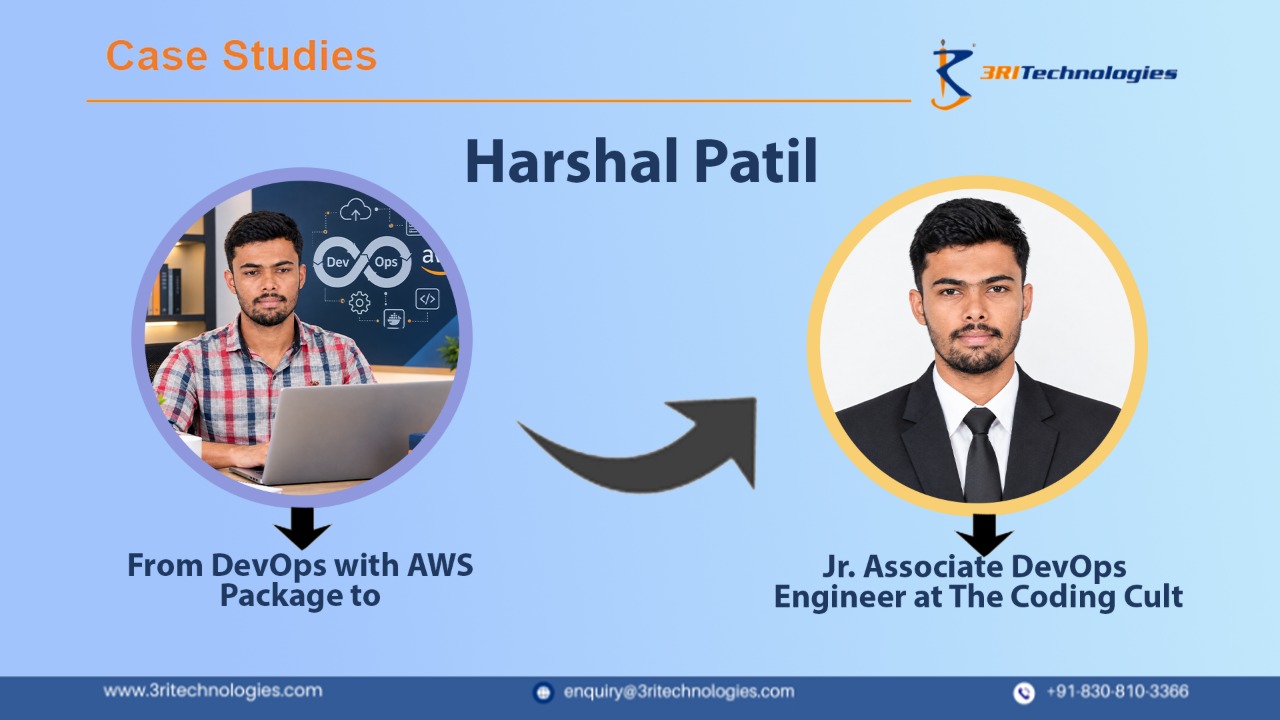
Harshal Mahendra Patil’s journey can help you understand how learning DevOps with AWS through practical training can support your career goals. He enrolled in the DevOps with AWS Package at 3RI Technologies, where he worked with AWS, Git, Jenkins, Docker, Kubernetes, Ansible, and Terraform. Along with learning the concepts, he worked on practical tasks and projects that helped him get familiar with using these tools. After completing his training, Harshal started working as a Jr. Associate DevOps Engineer at The Coding Cult, putting his DevOps and AWS knowledge to use in a professional role.
The Challenge
When Harshal started learning about DevOps, he found that there were many tools to understand, and it was not always easy to see how they were connected. Knowing what Git, Jenkins, AWS, or Docker does was one thing, but he wanted to know how these tools are actually used while working on a project.
He wanted more than just notes and theory. He was looking for a course where he could learn AWS and DevOps together, practice the tools himself, and work on tasks that felt closer to actual project work. Getting this kind of practice was important for him before stepping into a DevOps job.
The Learning Approach at 3RI Technologies
3RI Technologies offers a 4-month DevOps and AWS Package that includes practical training, project work, certification, and job assistance. The course covers AWS, Linux, Git, Jenkins, CI/CD, Ansible, Terraform, Docker, and Kubernetes, along with hands-on labs and real-time projects.
Harshal completed this training and worked with these tools during the course. The practical sessions and project work gave him a chance to practice areas such as AWS, Git, CI/CD, Docker, and automation. Working on these tasks helped him understand how different DevOps tools are used together while working on a project.
The DevOps Training Path in Pune
At 3RI Technologies, the DevOps and AWS Package runs for 4 months and includes technical sessions, practical labs, assignments, and project work. For Harshal, the training moved step by step, starting with the basics and gradually taking him into cloud, automation, deployment, and container technologies.
- Week 1: Harshal started by getting familiar with DevOps, Linux, and networking. These basics helped him understand how systems work before moving on to more advanced topics.
- Week 2: He then began learning about AWS and cloud computing. This gave him a clearer picture of how applications and infrastructure are managed on the cloud.
- Week 3: Harshal spent time with AWS services such as IAM and EC2. He learned about managing access and working with cloud-based servers.
- Week 4: His AWS learning continued with S3 and VPC. He got a better understanding of storing application data and setting up cloud networks.
- Week 5: He explored more AWS services, including RDS, DynamoDB, SNS, SQS, and Route 53. Working through these topics helped him see how different cloud services can support an application.
- Week 6: Harshal applied his AWS learning to project-related tasks. He worked through areas such as application deployment, security, backup, recovery, availability, and cost management.
- Week 7: He moved on to Git and GitHub. This was where he started working more closely with source code, changes, branches, and version control.
- Week 8: Harshal was introduced to Jenkins and CI/CD. He began understanding how repetitive development tasks can be automated instead of being done manually each time.
- Week 9: He continued practicing build and integration workflows using Jenkins and Maven. This helped him understand how different steps can be connected in a development process.
- Week 10: The focus shifted to monitoring. Harshal learned how tools such as Nagios, Prometheus, and Grafana can help teams keep track of applications and systems.
- Week 11: He started working with Ansible and learned how automation can make configuration and other repeated tasks easier to manage.
- Week 12: Harshal explored Terraform and the idea of managing infrastructure through code. This helped him understand a different way of setting up and maintaining cloud resources.
- Week 13: He began learning Docker and worked with the basic ideas behind images, containers, and Dockerfiles.
- Week 14: The training then moved into Kubernetes. Harshal learned how containerized applications can be deployed and managed in a Kubernetes environment.
- Week 15: By this stage, he started bringing his earlier learning together through CI/CD and project work. He could see how cloud, code management, automation, and containers fit into the same workflow.
- Week 16: The training ended with project work and career preparation. Harshal also worked on certification practice, resume preparation, interview questions, mock interviews, LinkedIn guidance, and placement activities.
Going through these topics step by step gave Harshal time to understand each part before moving ahead. The project work also gave him a chance to use what he had learned instead of keeping the training limited to theory. This helped him take his next step toward working as a Jr. Associate DevOps Engineer at The Coding Cult.
The Outcome of DevOps Classes in Pune
The DevOps Classes in Pune gave Harshal the opportunity to practise the technologies he was learning and build familiarity with common DevOps tasks.Some of the areas he worked on included
- DevOps and Cloud Concepts: He developed a better understanding of how DevOps practices and cloud technologies are used together.
- AWS Skills: He learned the basics of working with AWS and cloud infrastructure.
- DevOps Tools: He worked with Git, Jenkins, Docker, Kubernetes, Ansible, and Terraform during the course.
- Project Practice: Practical tasks helped him use the tools rather than only learning their functions theoretically.
- Interview Preparation: Resume work, mock interviews, and interview practice helped him prepare for job applications.
- Career Outcome: After completing his training, Harshal joined The Coding Cult as a Jr. Associate DevOps Engineer.
DevOps Training at 3RI Technologies
Want to learn DevOps in Pune with practical sessions and project work? 3RI Technologies’ DevOps with AWS Package covers key areas such as AWS, CI/CD, automation, Docker, Kubernetes, and Infrastructure as Code. The course also provides support for certification, resume preparation, interview practice, and placement activities.
For Harshal, this training helped him practice what he learned and take his first step into a DevOps role at The Coding Cult as a Jr. Associate DevOps Engineer.