
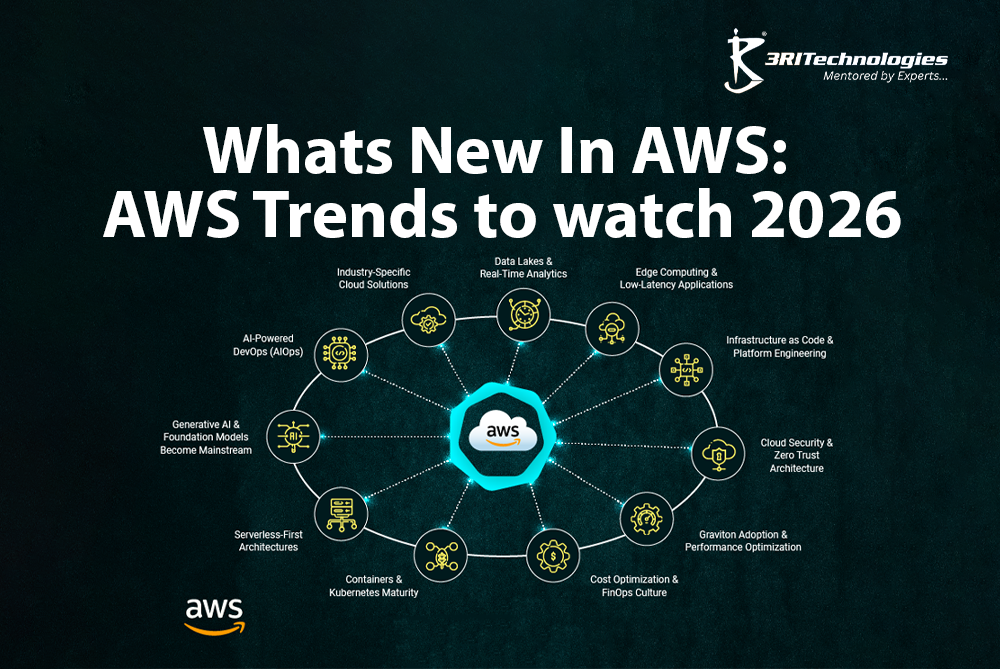
Cloud computing never stands still, and AWS keeps proving it year after year. In 2026, the platform is moving beyond simple hosting and storage into intelligent, self-optimizing infrastructure powered by generative AI, agentic automation, and greener data centers. For IT professionals, business owners, and students alike, keeping up with these shifts isn’t optional anymore—it’s the difference between staying relevant and falling behind. Many learners are turning to a structured AWS Course in Pune to build this foundation properly, since the platform is evolving faster than most self-study routines can keep up with. This article breaks down the biggest AWS trends of 2026 and what they mean for your career and business.
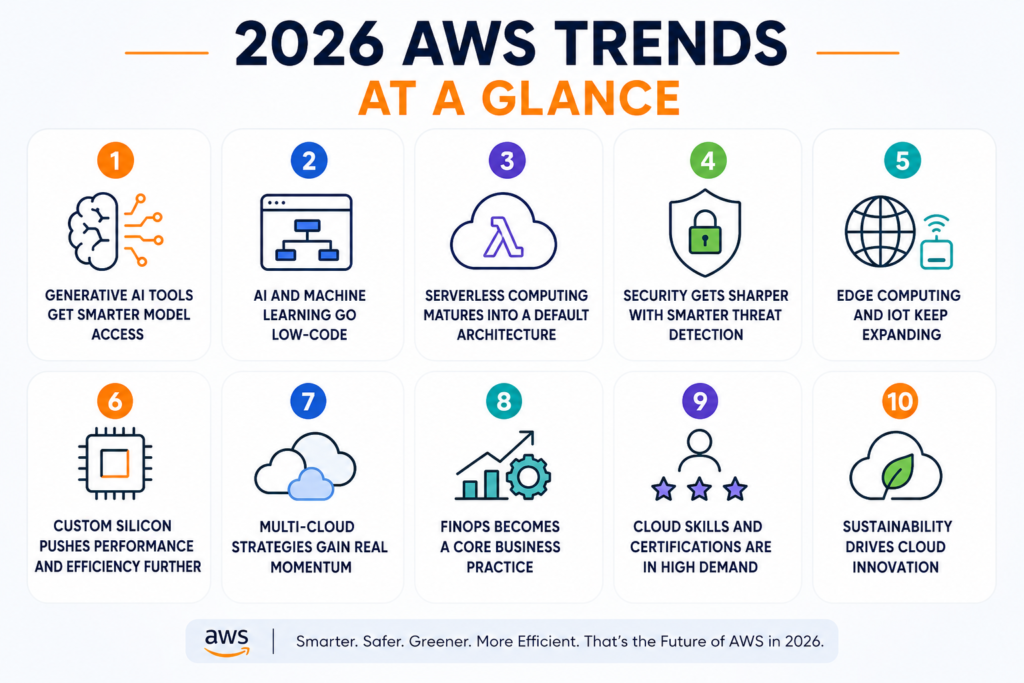
Top AWS Trends to Watch in 2026
AWS continues to expand its cloud services at a rapid pace. Here are ten shifts that are genuinely shaping the platform this year—the same areas learners at 3RI Technologies are trained on, so the skills translate directly into real, hireable capability.
1. Generative AI Tools Get Smarter Model Access
Bedrock now gives teams direct, managed access to a wide range of foundation models from multiple providers in one place, instead of stitching together separate AI infrastructure. Combined with tighter integration with high-performance GPU partners, model selection is now a business decision, not just an engineering one. This shift is largely what people mean when they talk about generative AI tools reshaping cloud strategy.
- One managed API to access several leading foundation models.
- Native support for retrieval-augmented generation so models can reference a company’s own data.
- Faster, cheaper experimentation before committing to a model in production.
2. AI and Machine Learning Go Low-Code
Building machine learning workflows no longer demands deep data-science expertise. AWS has expanded low-code and no-code tooling so business analysts and junior developers can build, train, and deploy models with visual workflows instead of writing everything from scratch.
- Drag-and-drop pipelines for common ML tasks like classification and forecasting.
- Pre-built templates that cut development time significantly.
- Easier handoff between business teams and technical teams.
3. Serverless Computing Matures Into a Default Architecture
Functions on AWS are no longer just short-lived and stateless. The platform has grown into a durable, event-driven fabric that supports long-running workflows like approvals and multi-step processes, while still scaling to zero when idle. This maturity is why serverless computing now sits at the center of most new application designs on AWS.
- Durable functions now handle processes that used to require dedicated servers.
- Streaming responses cut down user-facing latency for AI-driven apps.
- Databases increasingly scale automatically alongside serverless compute.
4. Security Gets Sharper With Smarter Threat Detection
Protection tools that guard applications from distributed attacks and automatically classify sensitive data are now paired with AI-driven monitoring, catching risks earlier and reducing manual review work. Getting this right has become non-negotiable, since cloud security failures are now a board-level concern rather than a purely technical one.
- Continuous, automated scanning for sensitive or misclassified data.
- Always-on protection against large-scale traffic-based attacks.
- Zero-trust principles applied by default, not as an afterthought.
5. Edge Computing and IoT Keep Expanding
As more devices generate real-time data, processing that data closer to its source has become essential. Edge computing on AWS reduces latency for IoT applications in manufacturing, logistics, and healthcare, while also cutting the energy cost of shipping raw data back to a central region.
- Local processing reduces response times for time-sensitive applications.
- Lower bandwidth costs by filtering data before it reaches the cloud.
- Better reliability for devices operating in low-connectivity environments.
6. Custom Silicon Pushes Performance and Efficiency Further
AWS’s latest generation of custom Arm-based processors delivers a major jump in core density, cache size, and energy efficiency compared to earlier chips, with formally verified isolation built directly into the hardware layer. This makes high-performance computing more affordable while keeping workloads more secure.
- Significantly higher performance per core than the previous chip generation.
- Better price-to-performance ratio for compute-heavy and AI workloads.
- Hardware-level isolation strengthens security without added configuration.
7. Multi-Cloud Strategies Gain Real Momentum
Enterprises are increasingly avoiding single-vendor dependency, spreading workloads across multiple cloud providers for resilience, negotiating power, and regulatory reasons. AWS has responded with better interoperability tools that make it easier to manage workloads that live partly outside its own ecosystem.
- Reduced risk of vendor lock-in for critical systems.
- Better disaster recovery through geographic and provider diversity.
- Growing demand for professionals who understand multi-cloud governance.
8. Quantum Computing Moves From Curiosity to Early Adoption
Quantum computing services on AWS now let researchers and enterprises experiment with quantum algorithms alongside classical computing resources, without owning specialized hardware. While still early-stage for most industries, sectors like finance, pharmaceuticals, and logistics are running pilot projects to prepare for what’s next.
- Pay-as-you-go access to multiple quantum hardware providers.
- Hybrid workflows that combine classical and quantum processing.
- A growing early-mover advantage for organizations experimenting now.



9. Sustainability Becomes a Core Design Principle
Green cloud strategies have shifted from a marketing talking point to an actual design requirement. Energy-efficient chips, smarter workload scheduling, and edge processing all contribute to lower power consumption, and sustainability metrics are now tracked alongside cost and performance.
- More data centers are being optimized for renewable energy usage.
- Efficient custom hardware reduces power draw per workload.
- Sustainability reporting is increasingly expected by enterprise customers.
10. Hybrid Cloud Bridges On-Premises and the Cloud
Not every workload can or should move fully to the cloud. Hybrid solutions let businesses keep sensitive or legacy systems on-premises while still connecting to AWS for scalability, analytics, and AI capabilities, giving them flexibility without a full migration.
- Useful for regulated industries with strict data-residency needs.
- Smooth extension of on-premises infrastructure into the cloud.
- A practical stepping stone for organizations not ready for full migration.
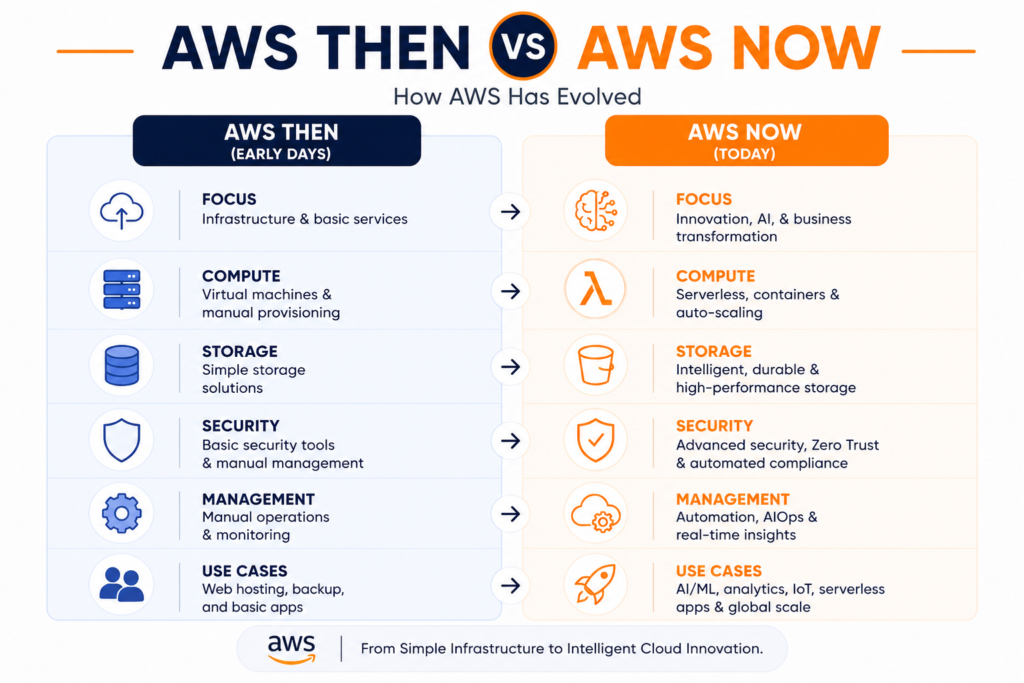
Quick Comparison: AWS Then vs AWS Now
| Aspect | AWS in Earlier Years | AWS Trends in 2026 |
| AI Usage | Basic ML APIs, limited automation | Generative AI tools, agentic workflows, low-code ML |
| Compute Model | Mostly server-based, early serverless adoption | Serverless-first, durable, and event-driven |
| Security Approach | Perimeter-based security | AI-assisted, always-on cloud security |
| Hardware | Standard general-purpose processors | Custom high-density, energy-efficient processors |
| Infrastructure Focus | Performance and uptime | Performance, sustainability, and edge efficiency |
How Can AWS Trends Help Your Career?
Understanding where AWS is headed isn’t just useful for engineers—it directly shapes career opportunities across roles. Companies everywhere are hiring for cloud skills, and those familiar with the newest AWS capabilities have a clear edge.
- Higher demand, better pay: Professionals skilled in generative AI, serverless design, and security consistently command premium salaries because these skills are in short supply.
- Career flexibility: AWS knowledge opens doors across roles—cloud architect, DevOps engineer, security analyst, data engineer, and AI/ML specialist.
- Future-proofing: As more enterprises shift workloads to the cloud, professionals who understand the current AWS cloud services ecosystem are far less likely to see their skills become outdated.
A support engineer who learns to build and monitor AI agents on AWS, for example, can transition into an AI operations role—a growing, well-paid specialization that barely existed a few years ago. Building this kind of career-ready skill set is exactly the outcome structured, mentor-led training is designed for.
Why Learning the Latest AWS Trends Is Important
Cloud platforms evolve constantly, and AWS releases new services and updates throughout the year. Falling behind on these changes can mean missing out on better, faster, and more secure ways of building applications.
- Efficiency gains: New serverless and automation features often let teams do more with fewer resources and less manual maintenance.
- Security compliance: As data regulations tighten globally, staying current on AWS security practices helps avoid costly compliance failures.
- Competitive advantage: Businesses that adopt trends like agentic AI and low-code machine learning early tend to outperform slower-moving competitors.
Understanding the AWS scope in future planning also helps IT leaders choose the right services instead of over-provisioning or under-utilizing resources. This is where structured AWS Classes in Pune tend to add real value, since guided learning paths generally cover new features faster and more systematically than self-study alone.
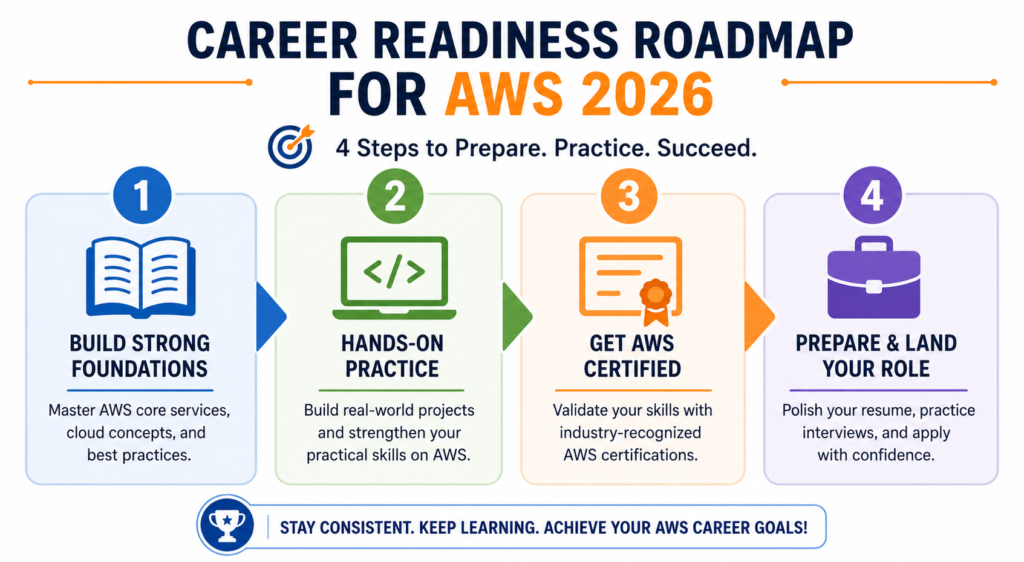
How to Get Ready for the Future of AWS
Preparing for what’s next in AWS doesn’t require mastering everything at once. A steady, practical approach works best.
- Start with the fundamentals: Get comfortable with core services like EC2, S3, IAM, and VPC before moving to advanced topics.
- Build hands-on projects: Deploy a serverless application, set up a basic AI agent using Bedrock, or configure a zero-trust security policy in a sandbox account.
- Follow the official roadmap: Regularly check AWS’s own announcements to understand where the platform is heading and which skills will matter most.
Certifications like AWS Certified Solutions Architect or AWS Certified AI Practitioner validate these skills to employers, but following the AWS roadmap on your own only goes so far.
Conclusion
AWS in 2026 is defined by smarter generative AI, low-code machine learning, mature serverless architecture, sharper security, and a growing focus on sustainability, edge computing, and hybrid infrastructure. These aren’t passing trends—they represent where enterprise cloud computing is genuinely headed. Whether you’re a working professional, a student, or a business decision-maker, understanding this shift matters. Enrolling in well-structured AWS Classes in Pune can give you the guided, hands-on practice needed to turn this understanding into real skill. Building the right foundation now positions you to take advantage of the opportunities this changing AWS landscape continues to create.
Frequently Asked Questions
1. What is the biggest AWS trend to watch in 2026?
Generative AI tools built around Bedrock stand out the most, with AWS enabling smarter, multi-model access and autonomous agents that can plan and complete multi-step tasks with minimal human oversight.
2. Is AWS still worth learning in 2026?
Yes. As more businesses adopt AWS cloud services for AI, serverless computing, and security, demand for skilled professionals continues to grow steadily across industries.
3. How is serverless computing changing on AWS?
It has expanded beyond simple functions into durable, stateful workflows that support long-running processes and integrate directly with generative AI tools for faster, more scalable applications.
4. What skills should I focus on for a future AWS career?
Prioritize serverless architecture, cloud security fundamentals, generative AI tools like Bedrock, and low-code machine learning, since these areas show the strongest hiring demand.


5. Where can I get practical, hands-on AWS training?
An AWS Course in Pune with hands-on labs and mentor support, such as the training offered by 3RI Technologies, can help you build practical, job-ready skills aligned with current industry trends.