
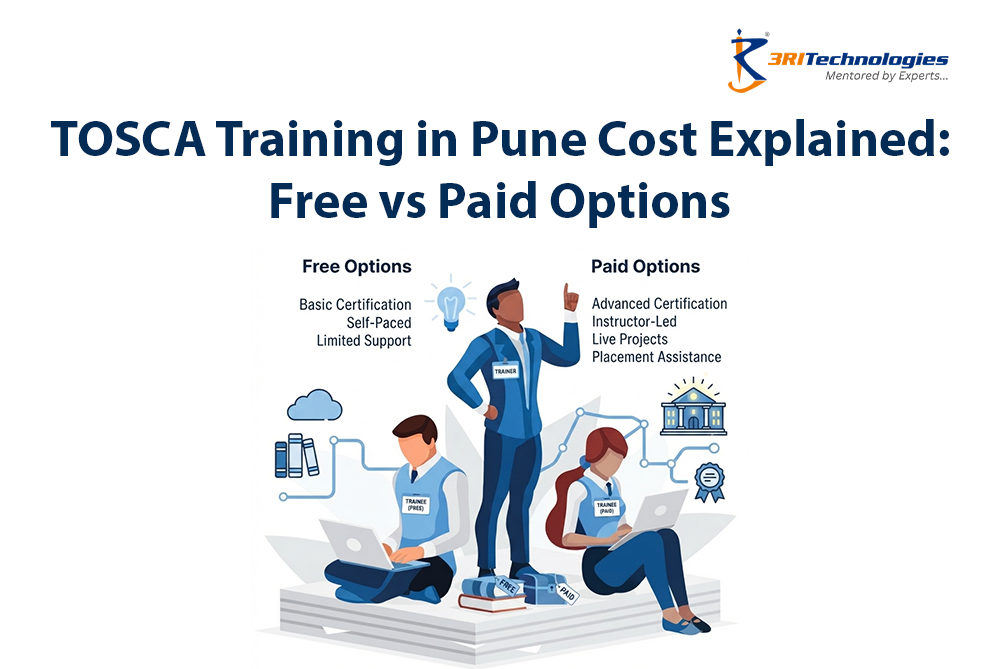
Planning to build a career in test automation? Tricentis TOSCA is one of the most widely used tools for scriptless, model-based automation, helping testers work faster without heavy coding skills. As companies shift toward DevOps and continuous testing, skilled automation professionals are in growing demand across industries like banking, SAP, and e-commerce, and this is exactly where TOSCA Training in Pune comes into the picture for aspiring QA professionals. But before enrolling, most learners have one common question: how much does it actually cost, and should you go for free resources or invest in a paid program? This blog breaks down both options in detail so you can make an informed, budget-friendly decision.
What Is the Average TOSCA Training Cost in Pune?
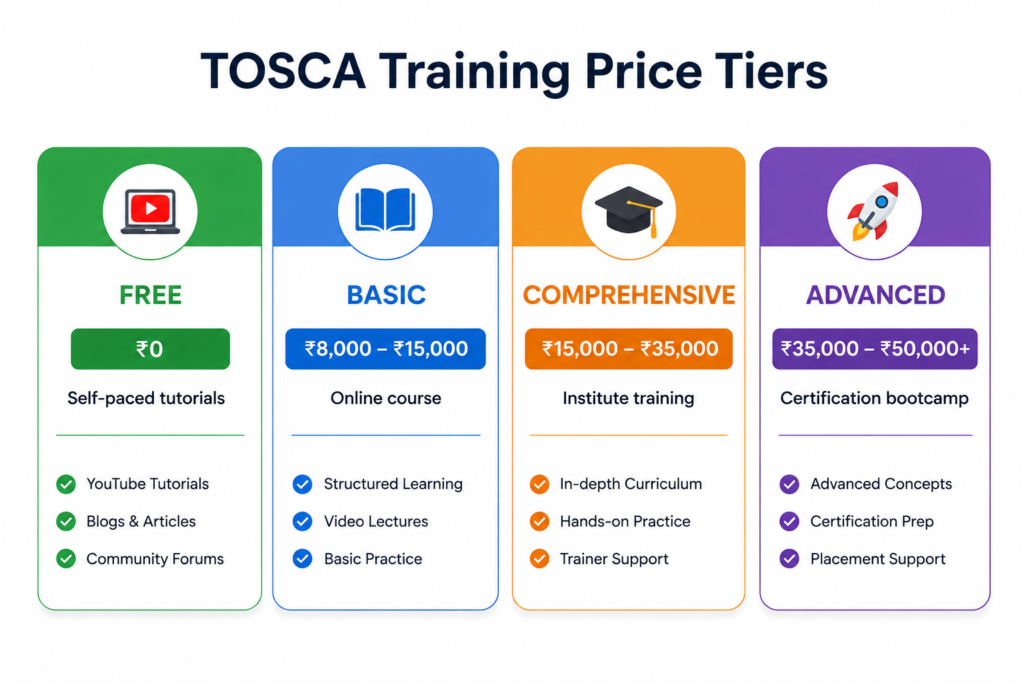
The TOSCA Training Cost in Pune varies widely depending on the mode of learning, trainer expertise, and course depth. On average, learners can expect the following price ranges:
- Free resources: ₹0 (YouTube tutorials, blogs, community forums)
- Basic online courses: ₹8,000 – ₹15,000
- Comprehensive institute-led training: ₹15,000 – ₹35,000
- Advanced/corporate-level bootcamps with certification prep: ₹35,000 – ₹50,000+
Several factors influence this pricing, including:
- Duration of the course (typically 30–60 hours)
- Whether live projects, sandbox labs, and case studies are included
- Availability of placement assistance and mentorship
- Trainer credentials and industry experience
- Depth of curriculum—basic module creation versus advanced topics like Test Data Management (TDM), API testing, and CI/CD integration
- Access to Tosca certification exam guidance
Pune, being a growing IT hub, offers a competitive mix of both free and paid TOSCA Courses in Pune, making it easier for learners at different budget levels to get started. The right investment ultimately depends on whether you’re testing the waters or preparing for a full-fledged automation testing career.
Free TOSCA Training Options: Features and Cost Benefits
Free TOSCA Training is a great starting point for beginners who want to explore the tool before committing financially. These options typically include:
- Free tutorials and guides: Covering the basics of Tricentis TOSCA—module creation, test case design, execution logs, and simple reporting.
- Trial version practice: Tricentis offers a trial edition, letting learners experiment with drag-and-drop test design and basic web element automation.
- Community-driven forums: Discussion groups and Q&A platforms where learners can ask real-time questions and access reusable automation assets.
- Occasional free webinars: Hosted by training providers to introduce beginners to the TOSCA ecosystem.
Benefits of free training:
- Zero financial risk while testing your interest in automation testing
- Flexible, self-paced learning that fits around a job or college schedule
- Useful for understanding core concepts like modules, test cases, and workflows
- Good exposure to the TOSCA interface before making a financial commitment
Limitations to consider:
- No structured curriculum or logical progression path
- Coverage rarely goes beyond basics—advanced areas like SAP automation, TDM, or CI/CD pipelines are almost never included
- Limited or no hands-on project exposure to real enterprise-style scenarios
- No doubt-resolution support or one-on-one mentorship
- No certificate of completion, which most employers expect
- No placement or interview preparation support
Free resources work well for initial exploration, but they rarely prepare learners for real-world job requirements or the Tosca certification exam, which demands practical, project-based understanding rather than just theoretical familiarity.
Paid TOSCA Training Options: Fees, Features, and Advantages
Paid TOSCA training is built for learners who are serious about turning automation testing into a career, not just a passing interest. Institutes like 3RI Technologies design their TOSCA Training in Pune programmes around this exact need, combining structured lessons with real project exposure so learners don’t just learn the tool—they learn how to apply it the way employers expect.
Paid TOSCA Training typically includes far greater depth than free tutorials, covering both foundational and advanced skills needed for enterprise-level automation. Here’s what a well-designed paid program usually offers:
1. Structured Curriculum
A paid course moves well beyond the basics, walking learners through topics such as
- Test Data Service (TDS) and Test Data Management (TDM) for handling dynamic test data
- Continuous integration with tools like Jenkins or Azure DevOps to support DevOps-driven testing pipelines
- Risk-based testing strategies and reusable automation frameworks
- End-to-end automation for SAP and other enterprise applications
2. Certification Support
Formal Tosca certification adds credibility to your resume and is widely recognized by employers as proof of practical competency. Paid programs typically prepare learners for exam levels such as
- Automation Specialist (Level 1 & 2)
- Test Design Specialist
- Execution Specialist


3. Practical Labs and Live Projects
Instead of isolated exercises, learners get hands-on exposure through:
- Sandbox environments that mimic real enterprise test setups
- Case studies modeled on actual company workflows
- Practice projects spanning API, mobile, and regression testing
4. Mentorship and Career Guidance
Dedicated trainers and mentors help learners with:
- Troubleshooting and debugging failed test runs
- Building and configuring automation pipelines
- Structured preparation for certification exams and technical interviews
Is Paid TOSCA Training Worth the Investment?
For most learners aiming to enter or switch into a QA automation role, paid training is worth the investment. Here’s why:
- Faster learning curve: Structured guidance reduces trial-and-error time significantly compared to self-learning through scattered tutorials.
- Certification readiness: Trainers help learners prepare specifically for the Tosca certification exam pattern, rather than leaving it to guesswork.
- Career support: Placement assistance and interview coaching directly impact job readiness and reduce the time it takes to land a role.
- Real project exposure: Employers consistently value hands-on experience with realistic test scenarios over theoretical knowledge alone.
- Better long-term ROI: Automation testing roles often pay a premium over manual testing positions, and certified professionals are frequently preferred during shortlisting, making the upfront course fee a worthwhile career investment.
For example, a fresher relying only on free YouTube videos may understand TOSCA’s interface but struggle to explain test design strategies, TDM concepts, or CI/CD integration in an interview. A paid, project-based course closes exactly this gap by simulating the kind of scenarios testers actually face on the job.
Free vs. Paid TOSCA Training: Cost Comparison and Value Analysis
Here’s a side-by-side comparison to help you evaluate both options clearly:
| Feature | Free TOSCA Training | Paid TOSCA Training |
| Cost | ₹0 | ₹8,000 – ₹50,000+ |
| Curriculum Structure | Unstructured | Structured, industry-aligned |
| Advanced Topics (TDM, API, SAP, CI/CD) | Rarely covered | Included |
| Hands-on Projects | Rare or none | Sandbox labs and real case studies |
| Certification Guidance | Not available | Available |
| Placement Assistance | Not available | Often included |
| Doubt Resolution | Limited (forums only) | Direct trainer support |
| Completion Certificate | No | Yes |
| Best Suited For | Beginners exploring the tool | Career-focused learners |
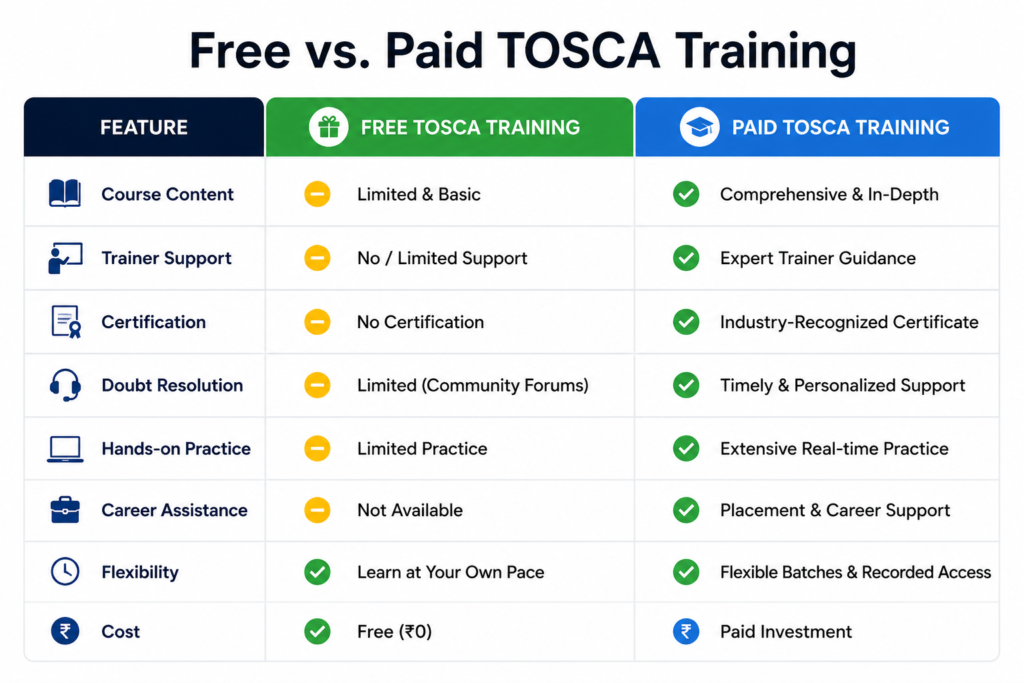
This comparison makes it clear that while free training saves money upfront, paid training often delivers better long-term value in terms of job readiness, certification support, and career growth. A common myth is that free tutorials alone are “enough”—in reality, they’re a good starting point but rarely substitute for structured, project-based learning when it comes to actually clearing interviews or exam-level certification questions.
Which TOSCA Training Option Is Better for You?
The right choice depends on your goals:
- Choose free training if you’re simply curious about test automation or want to test your interest before investing money.
- Choose paid training if you’re aiming for a QA automation job, a career switch, or certification within a defined timeline.
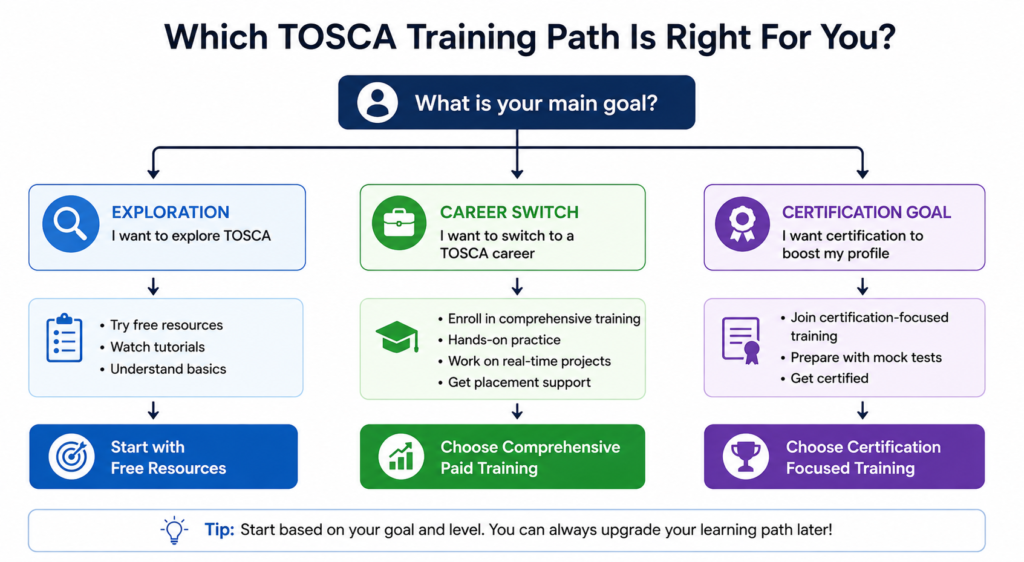
A useful way to decide is to ask yourself three questions: How soon do I need job-ready skills? Does my target role require certification? And how much time can I realistically spend on trial-and-error learning versus structured guidance? If speed and career outcomes matter more than saving a few thousand rupees upfront, paid training is usually the smarter path.
Many learners actually use a hybrid approach—starting with free tutorials to build basic familiarity with the TOSCA interface, then enrolling in a paid course once they’re ready for structured, job-oriented learning that covers certification and placement support.
Conclusion
Understanding the TOSCA Training Cost in Pune helps you plan your learning journey wisely. Free resources are useful for early exploration and building basic familiarity, but they lack structure, mentorship, and career support. Paid TOSCA Courses in Pune, on the other hand, offer a faster, more reliable path toward certification, advanced skills, and employment. Whichever route you choose, aligning your investment with your career goals and timeline will ensure you get the maximum return on both your time and money.
Frequently Asked Questions
1. What is the average cost of TOSCA training in Pune?
Costs vary depending on whether you choose free self-learning or a structured, institute-led program, with paid courses generally priced based on curriculum depth, hands-on projects, and placement support offered.
2. Is free TOSCA training enough to get a job?
Free training helps build basic understanding but usually lacks hands-on projects, advanced topics, and certification guidance, which most employers look for.



3. Does 3RI Technologies help with Tosca certification preparation?
Yes, the training approach at 3RI Technologies is built around preparing learners for certification exam levels, alongside practical, project-based learning that reinforces exam concepts.
4. How long does TOSCA training usually take?
Most structured courses run between 30–60 hours, depending on the depth of topics covered and whether live projects and certification prep are included.
5. Does 3RI Technologies provide placement assistance after TOSCA training?
Yes, learners get access to resume building, mock interviews, and placement guidance as part of the paid training experience, helping them transition into automation testing roles with confidence.